Affiliate Disclosure: This article contains affiliate links to Amazon. If you make a purchase through these links, we may earn a small commission at no extra cost to you. This helps support DINO TOYS and allows us to continue creating great content about dinosaurs!
Our Top Picks
⚡ Our top picks
Best overall Schleich T-Rex View on Amazon Most popular Jurassic World T-Rex View on Amazon Best LEGO set LEGO T-Rex Breakout View on Amazon Best overallSchleich T-Rex
★★★★☆ (12,400+ ratings)Hand-painted, museum-quality detail. 11.6 inches long. Non-toxic PVC, perfect for play and display.
Most popularJurassic World T-Rex
★★★★☆ (8,900+ ratings)Over 3 feet long with wide jaw that swallows mini figures. Movie-accurate sculpt from Jurassic World.
Best LEGO setLEGO T-Rex Breakout
★★★★☆ (5,200+ ratings)406 pieces, buildable T-Rex with posable limbs. Includes minifigures and fencing for epic breakout scenes.

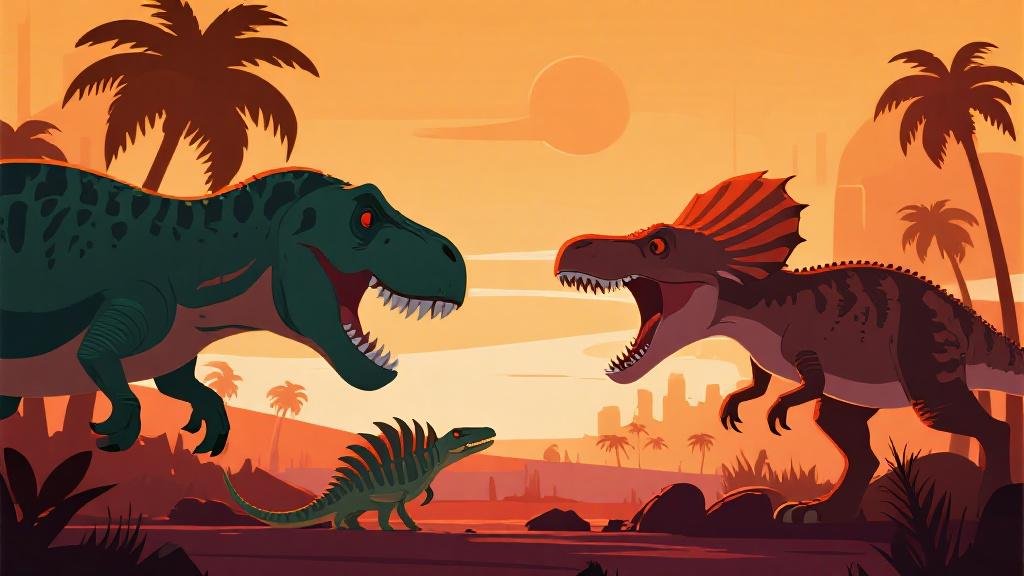
The T-Rex vs Spinosaurus debate is one of the biggest in paleontology and every schoolyard in America. Which was the ultimate apex predator? Could the massive Spinosaurus from Jurassic Park III really have taken down the king of the dinosaurs? We’re breaking down the real science behind T-Rex vs Spinosaurus — size, bite force, hunting style, habitat, and multiple fight scenarios — so you (and your dino-obsessed kid) can finally settle this debate with facts.
Spoiler: they never actually met in real life. But the comparison is still fascinating — and tells us a lot about how different predators evolved to dominate completely different environments.
Quick Picks: Best T-Rex and Spinosaurus Toys
- Best T-Rex figure: Schleich Tyrannosaurus Rex — museum-quality detail, articulated jaw
- Best Spinosaurus figure: PNSO Spinosaurus — scientifically accurate semi-aquatic design
- Best battle set: Schleich Dinosaurs Battle Pack — includes both predators for play battles
- Best LEGO T-Rex: LEGO Jurassic World T-Rex Breakout 76956 — 1,212 pieces
- Best for kids 4–8: Jurassic World Super Colossal T-Rex — 3.5 feet of wow factor
Meet the Contenders
Tyrannosaurus Rex
The Tyrannosaurus Rex lived 68–66 million years ago in western North America during the late Cretaceous. At up to 40 feet long and 9 tons, T-Rex was built like a living battering ram. Its skull alone was 5 feet long, housing 50–60 bone-crushing teeth that could exert up to 12,800 pounds of bite force — the strongest bite of any land animal in Earth’s history. Those tiny arms? Each one was still stronger than most adult humans. T-Rex had excellent binocular vision and one of the largest brains relative to body size of any dinosaur.
🛒 Shop T-Rex Figures on Amazon
Spinosaurus Aegyptiacus
The Spinosaurus lived 99–93 million years ago in North Africa during the mid-Cretaceous — roughly 30 million years before T-Rex existed. At 50–60 feet long, Spinosaurus was likely the largest carnivorous dinosaur ever. Its signature sail (supported by neural spines up to 5.4 feet tall) may have been used for display, thermoregulation, or swimming. Recent discoveries show Spinosaurus was semi-aquatic — with a paddle-like tail, dense bones for ballast, and a crocodile-like snout perfect for catching fish. Its bite force was estimated at only 2,000–4,000 pounds — powerful, but a fraction of T-Rex’s.
🛒 Shop Spinosaurus Figures on Amazon
Head-to-Head Comparison
- Length: Spinosaurus wins (50–60 ft vs 40 ft)
- Weight: Close — both around 7–9 tons, with Spinosaurus potentially heavier
- Bite force: T-Rex dominates (12,800 lbs vs 2,000–4,000 lbs)
- Teeth: T-Rex had thick, bone-crushing teeth; Spinosaurus had conical, fish-grabbing teeth
- Arms: Spinosaurus wins — long arms with large claws vs T-Rex’s famously short arms
- Speed on land: T-Rex likely faster (15–25 mph estimated vs Spinosaurus’s quadrupedal gait)
- Intelligence: T-Rex had a larger brain relative to body size
- Habitat: T-Rex was a pure land predator; Spinosaurus was semi-aquatic
Who Would Win? Scenario by Scenario
Scenario 1 — Open plain, no water
On dry land, the T-Rex wins decisively. T-Rex was built for land combat — powerful legs, massive bite force, and a body designed for tackling large prey like Triceratops and Edmontosaurus. Spinosaurus was adapted for water and fish-eating; its long, narrow jaws weren’t designed for biting through thick bone and muscle. On an open plain, T-Rex’s superior bite force and land agility would be overwhelming.
Scenario 2 — Riverbank or shallow water
In shallow water, this becomes more competitive. Spinosaurus has the advantage in its home turf — it could use its longer reach, powerful arms with large claws, and superior swimming ability. T-Rex would be less mobile in water. If Spinosaurus could drag the fight into deeper water, it could potentially win. But if T-Rex lands one bite, it’s probably over — that jaw pressure is simply unmatched.
Scenario 3 — Dense forest
T-Rex wins in a forest environment too. Its binocular vision and large brain made it an excellent hunter in complex terrain. Spinosaurus’s massive sail would be a liability among dense trees — it’s essentially a giant billboard saying “here I am.” T-Rex was more compact and maneuverable in tight spaces despite its size.
Scenario 4 — Night
T-Rex wins at night. Studies of T-Rex’s brain structure show it had excellent vision, including likely night vision capabilities. Its large olfactory bulbs also gave it an incredible sense of smell. Spinosaurus, as a primarily visual aquatic hunter, would be at a significant disadvantage in darkness on land.
Scenario 5 — If they actually met (they didn’t)
Here’s the thing: T-Rex and Spinosaurus never coexisted. Spinosaurus lived in North Africa 99–93 million years ago. T-Rex lived in North America 68–66 million years ago. They were separated by roughly 30 million years and an entire ocean. That’s a bigger time gap than separates us from T-Rex’s extinction. The Jurassic Park III fight is pure Hollywood fiction — entertaining, but scientifically impossible.
The Jurassic Park III Problem
In Jurassic Park III (2001), Spinosaurus defeats T-Rex by snapping its neck — a scene that outraged T-Rex fans and paleontologists alike. The movie’s Spinosaurus was based on outdated science from the 1990s that depicted it as a larger, bipedal super-predator. Modern science shows Spinosaurus was actually semi-aquatic with a paddle tail, more like a giant crocodile than a land-based apex predator. The movie fight was dramatic but not scientifically accurate.
What the Science Actually Says
Modern paleontology has given us a much clearer picture of both animals. T-Rex was the apex land predator — nothing on land could match its combination of bite force, speed, intelligence, and durability. Spinosaurus was the apex aquatic predator — the largest carnivorous dinosaur, perfectly adapted for hunting large fish and aquatic prey in North African river systems. They were champions of completely different domains, and comparing them is like comparing a lion to a great white shark — both apex predators, neither designed to fight the other.
Best Dinosaur Toys for T-Rex and Spinosaurus Fans
Schleich T-Rex vs Spinosaurus Battle Set
For kids who want to stage their own epic battles, Schleich’s dinosaur figures are the gold standard. Both the Schleich T-Rex and Schleich Spinosaurus feature hand-painted detail, articulated jaws, and durable PVC construction. Buy them together for the ultimate playground debate.
🛒 Check Today’s Price on Amazon
LEGO Jurassic World T-Rex Breakout 76956
This 1,212-piece LEGO set features one of the best T-Rex builds ever made. Perfect for dinosaur fans aged 8–12 who want a challenging, rewarding build with an incredible display piece at the end.
🛒 Check Today’s Price on Amazon
Frequently Asked Questions
Was Spinosaurus bigger than T-Rex?
Yes, Spinosaurus was longer than T-Rex — estimated at 50–60 feet vs T-Rex’s 40 feet. However, in terms of pure mass and combat ability, T-Rex was the more powerful land predator. Spinosaurus’s extra length came largely from its elongated skull and sail, not from additional muscle mass. Their weights were comparable at 7–9 tons each.
Could T-Rex beat Spinosaurus in a fight?
On land, T-Rex would almost certainly win. Its bite force (12,800 lbs) was 3–6 times stronger than Spinosaurus’s, and it was built for combat against large land animals. In water, Spinosaurus would have the advantage. In reality, they never met — they lived 30 million years apart on different continents.
Did T-Rex and Spinosaurus ever fight in real life?
No. T-Rex and Spinosaurus never coexisted. Spinosaurus lived in North Africa 99–93 million years ago, while T-Rex lived in North America 68–66 million years ago. They were separated by 30 million years and thousands of miles of ocean. The famous fight in Jurassic Park III was pure movie fiction.
What was the bite force of T-Rex vs Spinosaurus?
T-Rex’s bite force was estimated at 12,800 pounds — the strongest of any land animal ever. Spinosaurus’s bite force was estimated at 2,000–4,000 pounds — powerful, but designed for gripping slippery fish rather than crushing bone. T-Rex’s teeth were thick and serrated for tearing flesh; Spinosaurus’s were conical and interlocking for catching prey.
What are the best T-Rex and Spinosaurus toys for kids?
The Schleich Tyrannosaurus Rex and PNSO Spinosaurus are the most scientifically accurate figures available. For younger kids, the Jurassic World Super Colossal T-Rex (3.5 feet long) delivers pure wow factor. For builders, the LEGO T-Rex Breakout 76956 is the best dinosaur LEGO set on the market. See our best T-Rex toys guide for the full comparison.
Related Dinosaur Toy Guides
- Best T-Rex Toys — Top Picks for All Ages
- Realistic Dinosaur Figures — Museum-Quality Picks
- Best Dinosaur LEGO Sets for Kids
- Best Jurassic World Toys for Kids
- Best Dinosaur Toys 2026 — Complete Guide
- Feathered Dinosaurs: Science and Toys
- The Mesozoic Era Explained
- Best Dinosaur Dig Kits for Kids
- Best Dinosaur Toys by Age